Why Some Students Train for 30 Years and Never Leave the Shoden level
Insights from this year's training in Japan
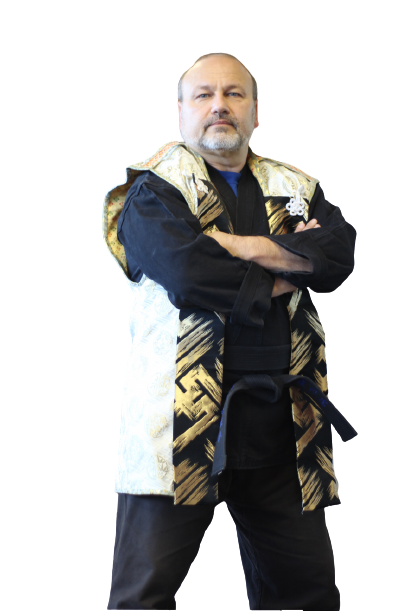
by Dai-Shihan Jeffrey Miller
Bujinkan Ninjutsu Master-Teacher
Initiated Tendai-Mikkyo Lay-Teacher
How is it possible for someone to train for thirty years and still have a beginner's understanding of the art?
Not because they lack knowledge.
Not because they lack rank.
Not because they lack dedication.
And certainly not because they haven't put in the time.
The answer may be much simpler—and much more uncomfortable.
They're still asking: "What technique do I do?"
Instead of: "What is this technique trying to teach me?"
That distinction may seem small, but it represents one of the biggest differences between students who continue to grow and those who eventually plateau.
The Trap of Technique Collection
Most martial artists begin their journey by learning techniques. This is normal, yes?
We learn:
- strikes,
- kicks,
- throws,
- locks,
- kata,
- forms,
- combinations.
At this stage, the primary question is:
"What do I do?"
The problem is that many practitioners never move beyond this question. Years pass.
More techniques are learned.
More kata are memorized.
More seminars are attended.
More notes are collected. But...
...the focus remains the same: "Show me the next technique."
Eventually, progress slows. Not because there is nothing left to learn. But because the student is still looking at the art through the same lens they used as a beginner.
Everything starts to look the same. Boredom sets in and, well... I'm sure you know what happens next.
Hatsumi Sensei's "Beginner's Mind"
Over the years, Hatsumi Sensei often spoke about practitioners who held high rank but still possessed a beginner's understanding. Many people misunderstood this as a criticism of technical skill.
I don't believe that was his point.
A person may have:
- decades of training,
- extensive technical knowledge,
- high rank,
- teaching experience,
...and still remain focused primarily on: "What technique should I use?"
The issue isn't knowledge. The issue is attention. What are you actually studying?
The movement?
Or the lesson hidden within the movement?
The Difference Between Practice and Research
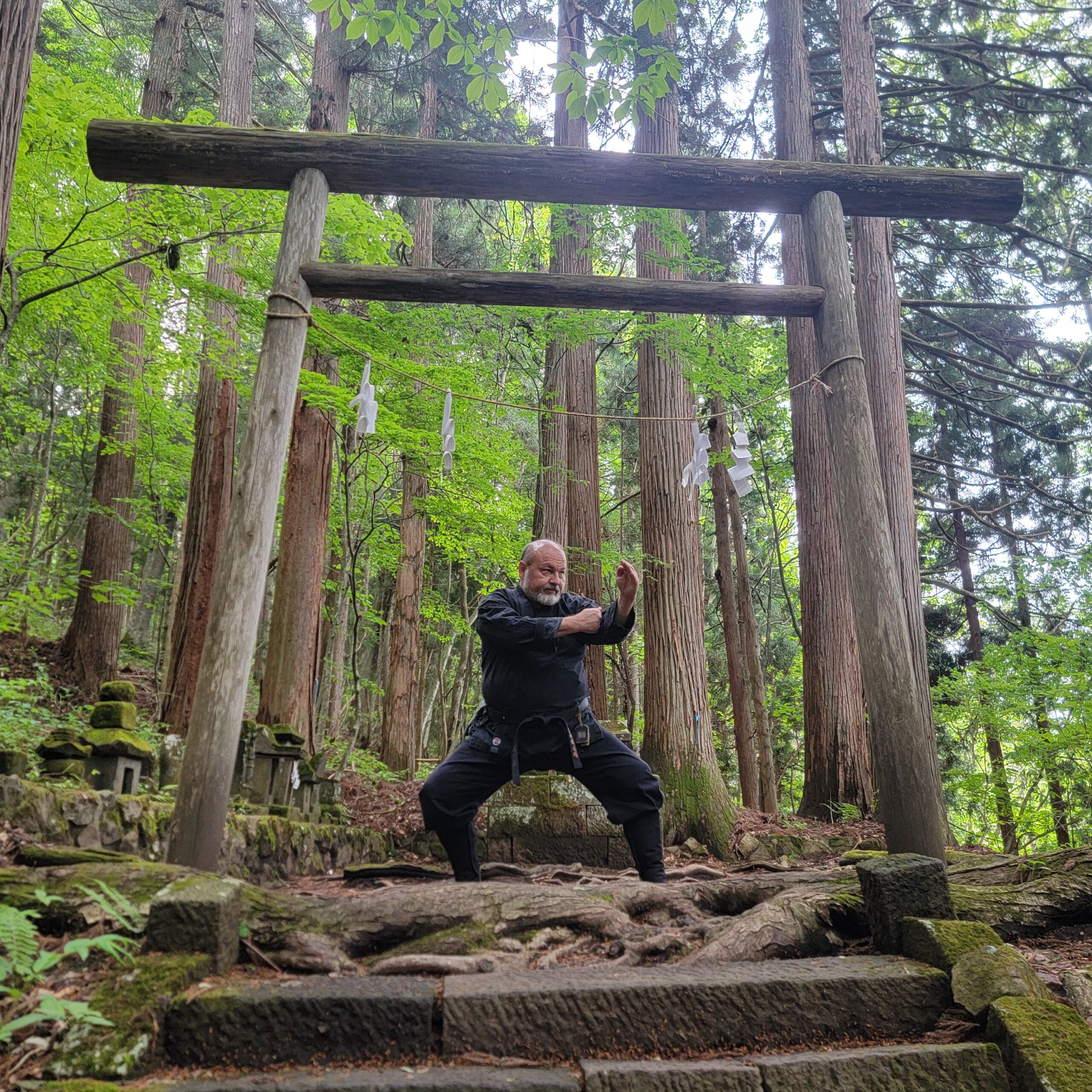
During my recent training in Japan, one phrase appeared repeatedly among several of the senior teachers.
Jishu Kenkyū.
Self-research.
Independent investigation.
Continued study.
Shiraishi Sensei repeatedly encouraged students to:"Do your best with this idea. Then continue studying it when you return home."
Notice what he didn't say.
He didn't say: "You now know it."
He didn't say: "Here's the answer."
He didn't say: "Move on to the next thing."
Instead, he pointed students back toward continued investigation. The lesson wasn't finished. The lesson had just begun.
Nagato Sensei's Frustration
One of the recurring themes throughout the trip was a frustration expressed—sometimes directly, sometimes indirectly—by several of the senior teachers.
Many practitioners were struggling with advanced concepts because they no longer possessed a deep understanding of the basics.
Not because they had never learned them.
Because they had stopped studying them.
The assumption had become: "I already know that."
But do you? Or are you simply familiar with it?
There is a difference.
The Oni Kudaki Lesson
Consider the technique: Oni Kudaki.
Most students see a joint lock. The technique becomes the focus.
But during corrections, what often emerged was something much deeper.
Small details such as:
- arm positioning,
- shoulder alignment,
- angle of entry,
- body placement,
...were not being corrected simply for aesthetics.
They were being corrected because those details affected:
- balance,
- recovery,
- counterattack potential,
- escape opportunities,
- control.
The lock itself was almost the least interesting part.
The real lesson was hidden in the conditions that made the lock inevitable.
The beginner sees: "Oni Kudaki."
The researcher asks: "What is Oni Kudaki, and the different parts of the basic form, trying to teach me?"
Those are very different questions.
Time in Training Does Not Equal Level of Understanding
One of the most common assumptions in martial arts is that time automatically creates progress.
But experience tells us otherwise.
Two students may:
- train for the same number of years,
- attend the same seminars,
- learn from the same teachers,
- practice the same kata,
...and still arrive at dramatically different levels of understanding.
Why?
Because exposure and understanding are not the same thing.
Repetition and refinement are not the same thing.
Time and study and deep investigation are not the same thing.
The calendar measures how long you've been exposed to a lesson. It does not measure how deeply you've studied it.
The Research Mindset
A technique-oriented student asks: "Can I do it?"
A research-oriented student asks: "What makes this work, and what else is hidden inside it?"
One person seeks completion.
The other seeks discovery.
One eventually reaches a plateau.
The other can continue growing for decades.
This is why the senior Japanese teachers continue revisiting lessons they first encountered years ago.
Not because they forgot them.
Because they are still discovering them.
The Real Purpose of Training
Perhaps the greatest lesson I brought back from Japan this year wasn't a new technique.
It was a reminder that mastery is not the accumulation of answers. It's the refinement of questions. Because...
...the more precise the question, the clearer the answer. Which itself... leads to more questions. That's why it's called a "path," and not a destination!
The purpose of training is not merely to learn techniques. The purpose of training is to develop the ability to continue learning from them.
That's the spirit of Jishu Kenkyū... "self-researcher, study, investigation."
And that may be one of the most important lessons a serious martial artist can learn. That you will only learn 10% of the art from your teacher. The rest you must discover for yourself.
Join Us at Spring Camp
This year's annual Spring Ninjutsu Camp Intensive isn't about collecting more techniques.
It's about understanding how the Japanese teachers continue learning from the techniques they already know... and how we can, too.
We'll explore:
- the evolution of training,
- the progression from technique to principle,
- the difference between drills, attributes, and applications,
- and how to continue uncovering deeper lessons hidden inside your existing training.
Because the greatest breakthroughs often don't come from learning something new.
They come from seeing what you've already learned in a completely different way.
Live dojo and virtual Zoom access options available.
Register here: https://onlineninjaacademy.com/spring-camp-japan-recap/
I look forward to training with you again very soon!

ABOUT YOUR INSTRUCTOR
Dai-Shihan Jeffrey Miller is an internationally-recognized self-defense expert, teacher, speaker, and author. He is a personal student of Soke Masaaki Hatsumi, 34th Grandmaster of the Togakure school of Ninjutsu and 8 other classical systems of Japanese combat and personal warrior mastery.
He has trained in the martial arts since 1975, studying a virtual encyclopedia of martial arts - arts like Goju-Ryu Karate, Tae kwon do, Jeet Kune Do, and many others. As a former federal police officer, member of the U.S. Army Military Police Corps, and a private security specialist and violence consultant, his primary focys os on helping to translate these proven, time-tested lessons and skills for use by serious warrior-protectors in the modern world of the 21st century!
His knowledge and real-world street experience through which he filters these lessons, and his direct, personal understanding of what it takes to handle actual, violence and violent people makes him the perfect choice for those looking to develop the ability to protect themselves and others from danger!