
What if the biggest obstacle to your progress isn't a lack of training or techniques?
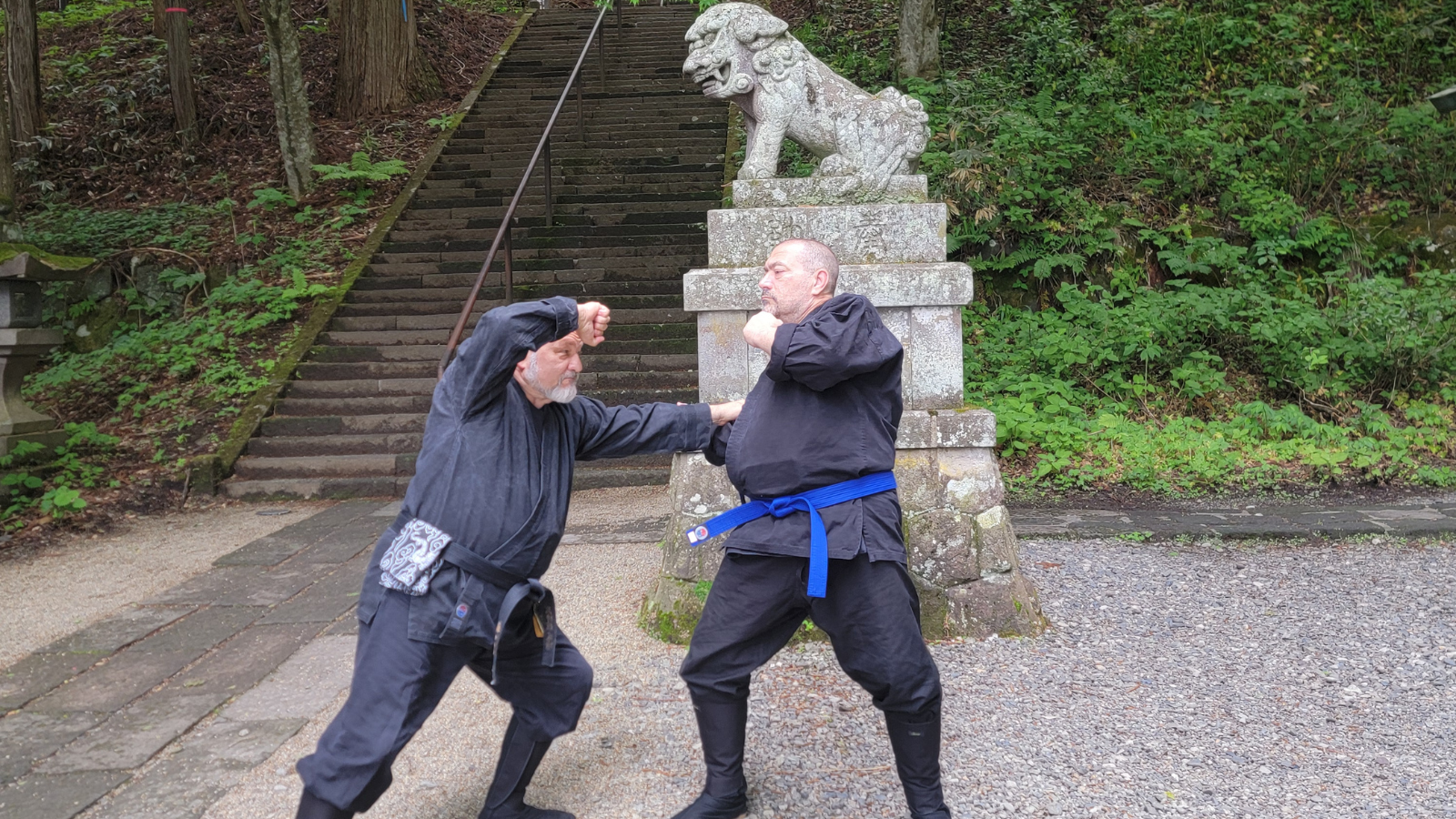
Pictured: Training at Togakushi with student Kyle V. during my recent Japan study trip. The setting was historic. The lesson was timeless: the basics still have more to teach us.
What if it's the way you've been thinking about training itself?
Recently, while training in Japan with several of the most senior teachers in our art, I was reminded of something I've observed repeatedly over the last four decades.
Some practitioners continue growing year after year.
Others seem to reach a plateau.
Ironically, the difference often has very little to do with:
- talent,
- athleticism,
- age,
- rank,
- or even time spent training.
In fact, I've met practitioners with decades of experience who still struggle with lessons hidden inside the most basic techniques.
I've also met students with far less time in the art who seem to discover deeper insights at an accelerated pace.
Why?
The answer may have nothing to do with how many techniques you know and everything to do with what you believe those techniques are for.
The Japanese teachers repeatedly reminded us that the greatest lessons are often hidden in plain sight—not inside some secret advanced kata, but inside movements we've practiced hundreds or even thousands of times before.
The question is:
Are you still studying them?
The Lesson Was Never the Technique
One of the Biggest Lessons I Brought Back From Japan This Year
by Dai-Shihan Jeffrey Miller
Bujinkan Ninjutsu Master-Teacher
Initiated Tendai-Mikkyo Lay-Teacher
One of the biggest lessons I brought back from Japan this year wasn't a new technique.
In fact, it wasn't a technique at all.
It was a reminder that many students spend years studying movements while missing the lesson the movement was designed to teach.
This may be one of the biggest reasons practitioners plateau.
Not because they stop training.
Not because they stop attending seminars.
Not because they stop practicing.
But because they become attached to the visible exercise and lose sight of the invisible ability being developed.
In other words:
They remember the movement.
They forget the lesson.
Building Abilities vs Collecting Techniques
One of the reasons this lesson stood out so clearly during my recent training in Japan is that it reinforces a philosophy I've intentionally built into our own curriculum for decades.
Many martial arts systems—and many students—approach rank progression as an accumulation process.
At each level, new techniques are added.
Then more techniques.
Then more techniques.
The student's "toolbox" grows larger.
There is certainly value in this approach.
However, I've always been more interested in developing abilities than collecting techniques.
This is why our curriculum is organized into developmental phases, or modules, rather than simply a growing list of techniques to memorize.
Each phase is designed to develop specific attributes:
- structure,
- power,
- balance,
- timing,
- adaptability,
- perception,
- freedom of movement.
The techniques are important.
But they are not the primary goal.
They are the training vehicles used to develop those abilities.
This means each phase depends upon the previous one.
Not because students need more techniques.
But because they need the attributes those techniques were designed to develop.
This is where many practitioners become confused, not just with regards to why my curriculum is designed the way it is, but in the difference between these two perspectives and approaches.
They see the next technique.
They miss the next ability.
And when that happens, advancement becomes more about accumulation rather than evolution.
The Module 2 and Module 3 Problem
I see this happen regularly within our own curriculum.
A student reaches Module 2 - a study of what we call the "Water Realm," and learns larger, more committed body movements. This is the realm of scientific application, long-range defensive angling, and power through body-weight-in-motion.
The strikes here often involve a visible "wind-up" that resembles the movement of a baseball pitcher throwing a fastball.
Many students immediately assume:
"This is how I'm supposed to strike."
Not exactly.
The movement itself isn't the lesson.
The lesson is "power generation."
The student is learning:
- body connection,
- weight transfer,
- hip engagement,
- structure,
- momentum,
- whole-body power.
The larger motion exaggerates these elements so they can be felt and understood.
The movement is the teaching tool.
The power generation is the lesson.
Then the student reaches Module 3.
Suddenly the movement becomes smaller.
More direct.
Faster.
Less obvious.
Now many students make the opposite mistake.
They conclude:
"The Module 2 movement was wrong." Or, they think that was for the last rank, now I'm doing something new and different.
No.
The Module 2 movement taught the attribute that makes the Module 3 movement possible. It can be and is a strategy in and of itself, but...
The wind-up was never the lesson.
The power generation was.
Likewise:
The direct strike they're now doing in module 3 is not the lesson.
The direct committed action, pre-emptive timing, and efficiency of movement is the lesson.
The student who only sees movements - who only sees techniques - becomes confused by these apparent differences.
The student who sees attributes, principles, and strategic concepts understands the progression being taught and learned.
The Same Mistake Happens in Japan
One of the recurring themes during this year's training in Japan was watching senior teachers demonstrate subtle movement that many practitioners immediately wanted to copy.
This is understandable. And, it's even correct in the earliest stages of training - in the shu stage, where imitation and copying the teacher's movement IS the point. But we can't stay here if we're to develop past the infancy of our training and development. At a certain point, we have to stop looking at "what's happening," and start asking "what makes that work?"
We see:
- Noguchi Sensei move effortlessly.
- Shiraishi Sensei create balance breaks almost invisibly.
- Nagato Sensei apply familiar techniques in ways that feel completely different.
The temptation from the beginner's mindset is immediate: "How do I move like that?"
But that's often the wrong question as we're trying to grow past that initial level of progress.
At this point, the better question is: "What ability or abilities allow him to move like that?"
Those are very different lines of thinking - very different avenues of research, inquiry, and investigation.
One seeks imitation.
The other seeks understanding.
Kata Are Not the Lesson
This may be one of the most misunderstood aspects of traditional martial arts training. And, for people who say they "only want to do it the 'traditional' way, they should understand what that means.
Students often view kata as finished answers. Nay-sayers to the art say they're BS because you can't fight with kata on the street.
Students memorize:
- the sequence,
- the footwork,
- the hand positions,
- the timing.
Then they assume they've learned the kata.
Nay-sayers see the form, assume they know better, ignore it and move on feeling smug and righteous in their determination.
But what if the kata was never the lesson?
What if the kata was merely the laboratory?
A place where:
- timing can be explored,
- balance can be studied,
- distance can be refined,
- perception can be developed,
- conditions can be manipulated or, at best...
- potentials and outcomes can be learned?
Now the kata becomes much more interesting.
Instead of asking: "Can I perform the kata?" Or, "does this really work on the street?"
You begin asking: "What is this kata trying to teach me?"
That question can keep a student busy for decades.
Gyokko-Ryu Changed My Perspective...again
While training with Noguchi Sensei in one of the classes where we were working through some of the initial kata of the joryaku scroll - Koku, Renyo, Dan-shu, Danshi - one of the things that stood out wasn't a new version or variation of each kata.
It was how much control was established before the visible technique ever appeared.
Many students think: The technique is the control.
But more and more I am seeing the opposite.
The control often happens first.
The completed technique simply shows that the control already existed.
Balance is compromised.
Recovery is interrupted.
Options disappear... for him, not you.
The attacker loses freedom.
Then the technique appears.
The visible movement is often the final consequence, not the beginning.
Again: The lesson was never the technique.
The lesson was understanding, and being able to create the conditions that made the technique... inevitable. No matter how much he resisted, tried to counter, or anything else... it just does matter when these things are correct.
The Difference Between a Drill and a Fight
Another realization from Japan was how often students confuse developmental exercises with actual self-defense applications.
This creates endless debates.
Someone watches a demonstration and says: "That wouldn't work in a real fight."
But what if the teacher wasn't demonstrating a fight?
What if he was demonstrating:
- body dynamics,
- balance recovery,
- pressure sensitivity,
- timing,
- structure,
- kukan awareness?
Then the criticism misses the point entirely.
A balance drill is not a fight.
A movement exercise is not a fight.
A sensitivity drill is not a fight.
Yet each may contribute enormously to fighting ability - may have everything to do with how effectively you can survive a dangerous situation.
This distinction may be one of the most important lessons a student can learn.
Not every exercise is teaching a technique or how to win a fight - per se.
Some are teaching an ability that, when used properly, can make winning quicker, easier, and more energy-efficient.
The Kukan Example
This is especially true with kukan-based training.
Many students watch advanced practitioners and think: "I don't understand what technique they're doing."
Sometimes that's because there isn't one. At least not in the conventional sense.
The teacher may be exploring:
- space,
- timing,
- perception,
- recovery,
- structure.
The visible movement becomes secondary. The lesson has moved elsewhere.
Again: The lesson was never the technique.
Collecting Techniques vs Developing Capability
This distinction may explain why some practitioners continue growing while others plateau. Students who focus on movements tend to collect techniques. Students who focus on abilities develop capability.
One asks: "What do I do?"
The other asks: "What ability is this trying to develop?"
One seeks more answers. The other develops more options.
One accumulates information. The other accumulates freedom.
And in the long run, freedom is usually the more valuable asset.
A Better Question
Perhaps one of the best questions a student can ask at this level is not: "How do I do this technique?"
But: "What is this technique trying to teach me?"
That simple shift changes everything.
Suddenly:
- kata become deeper,
- drills become more meaningful,
- corrections become more valuable,
- and training becomes an ongoing process of discovery.
The same lesson can continue revealing itself for years.
Join Us for this Year's Annual Spring Ninjutsu Camp Intensive
This year's Spring Camp is not about learning a collection of new techniques, although we WILL be working on techniques.
It's about learning how to see your existing techniques differently.
We'll explore:
- the evolution of training,
- the progression from mechanics to principles,
- how the Japanese teachers continue researching lessons they first encountered decades ago,
- and how to uncover the deeper abilities hidden inside the movements you already know.
Because the greatest breakthroughs rarely come from adding another technique.
They come from discovering what the technique was trying to teach you all along! And...
...isn't that what we're all looking for - how to learn the lessons the past masters were teaching, and how to apply those techniques and lessons to produce not just results, but the Power, Confidence, and Control we've been looking for?
OTHER RESOURCES AND TRAINING PROGRAMS...
For readers who want to explore these ideas further, I’ve collected several short essays that expand on the same principles—why efficiency, adaptability, and judgment matter more than aggression.
FREE WEEKLY ONLINE TRAINING FROM DAI-SHIHAN MILLER!
Mindset, Life-Master, and Warrior Living for the modern protector!
Monday Evenings at 8pm eastern
Strategies and Tactics to Put More Power & "Bite" in Your Techniques!
Wednesday Afternoons at 3pm eastern
New Accelerated "Foundations of Ninja Self-Defense" Online & Distance Learning Program!

Just because you can fight or carry a gun, doesn't mean you have a broad enough skill set or the skill-proficiency to handle any attacker, any fight style, or any threat scenario that could come at you, quickly, efficiently, and with the least amount of wear-and-tear on your in the process! This "foundations" course has more in it than most full programs! Remember: "The one with the most options has the greatest chance for success!" -- Jeffrey Miller
Ninpo-Masterclass
Online Virtual Ninjutsu-Based Self-Protection Training Classes
with Dai-Shihan Miller!
Proven, Time-Tested Lessons for the Modern Warrior-Protector!
Ninpo-mastery + Group Coaching
Perfect for students ready to deepen their training and receive direct guidance. Includes 6 months of access to weekly Zoom Masterclasses, entry to Seishin Teki Kyoyo, a private strategy session with Jeffrey, and ongoing coaching support. Limited to 10 participants.
About the Author & Instructor...
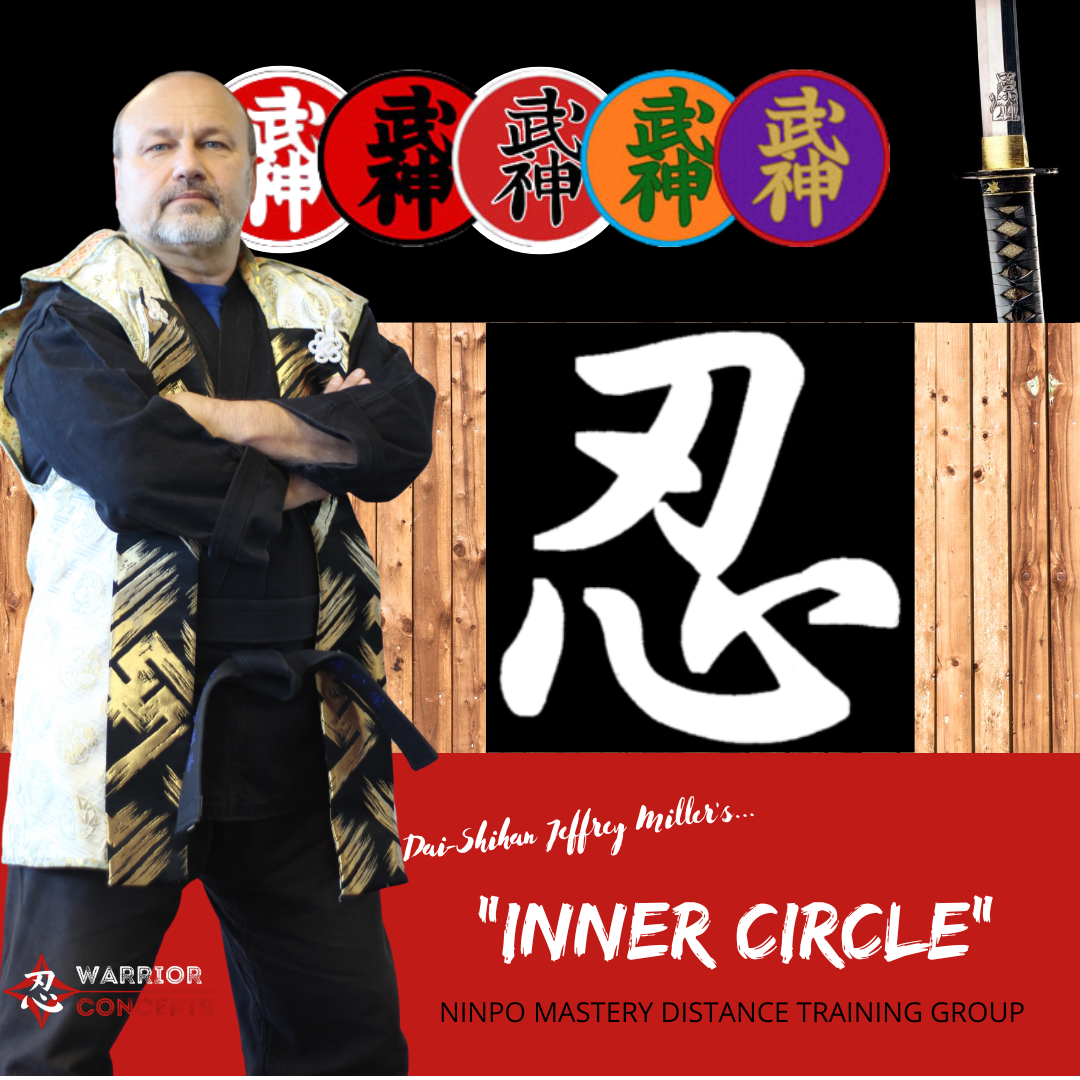
Dai-Shihan Jeffrey M. Miller SPS, DTI
About the Master Instructor
Dai-Shihan Miller is one of the longest training students and teachers of Bujinkan Ninjutsu. He has trained with top teachers of the martial and meditation sciences on 3 continents and in 6 countries; including with Soke Masaaki Hatsumi (Grandmaster of 9 historical schools of Japanese warriorship), Senior Japanese and Western Master Teachers, and Rev. Jikai Choffy (ordained teacher of Tendai Mikkyo - Japanese esoteric Buddhist mind-science).
A Personal Note From Dai-Shihan Miller...
Hello and welcome to the Online Ninja Academy...
As a solo and long-distance student myself, I knew the hardships that many students - those who had a burning desire to study the true budo and life mastery teachings of the ancient Ninja and Samurai warriors - had in trying to learn from just videos or books. Many, like me and my own teachers, lacked a qualified dojo in their own area and lived too far from a certified teacher of authentic Ninjutsu.
That's why I created what was to be one of the first online Ninjutsu training programs. Combining the use of internet technologies with a unique curriculum and live training opportunities, I created a means for students to get the access and feedback from a teacher - the greatest issue and objection many had with regards to video and online training. Now, you can join thousands of students, just like yourself, in gaining the benefits, results, and success you've been looking for!

Dai-Shihan Jeffrey M. Miller SPS, DTI
Bujinkan Ninjutsu Master-Teacher
Founder, Warrior Concepts International
Founder & Master Instructor, Bujinkan Mori no Tora Dojo
Internationally-Recognized Author, Speaker, & Consultant Corporate Security, Emergency Management, & Workplace Violence Consultant