

Why Technique Isn’t the Problem—and Why “Fighting Harder” Isn’t the Answer
From time to time, videos circulate showing trained martial artists being overwhelmed by someone with no apparent training. Critics point to these clips as proof that traditional training “doesn’t work on the street,” while others use them to justify a shift toward brute-force, fight-club-style approaches.
Both reactions miss the point.
The issue isn’t that training fails.
And it isn’t that restraint or structure are liabilities.
The real problem is how people are taught to think about violence, danger, and resolution.
Real-world self-defense rarely unfolds in clean stages. Attacks don’t always follow recognizable patterns, pain doesn’t reliably stop intent, and situations don’t end simply because a technique was successful. When training quietly reinforces those assumptions, even skilled practitioners can hesitate—or disengage too early—when reality doesn’t cooperate.
This article examines why trained people sometimes lose to untrained attackers, not to undermine training, but to clarify what effective self-defense actually requires: adaptability, continuous assessment, and the ability to respond based on what is happening—not what should be happening.
If your goal is not to “win a fight,” but to protect yourself, regain control, and get home safely, this perspective matters.
Why Trained People Lose to Untrained Attackers
—and Why “Fight Like Everyone Else” Is the Wrong Fix
by Dai-Shihan Jeffrey Miller
Bujinkan Ninjutsu Master-Teacher
Initiated Tendai-Mikkyo Lay-Teacher

One of the most uncomfortable realities in self-defense—and one that critics are right to point out—is that trained martial artists and self-defense practitioners are sometimes beaten by untrained attackers.
Videos circulate. Stories spread. And the conclusion is often delivered with smug certainty:
“See? Training doesn’t work on the street.”
From there, a second and equally flawed conclusion usually follows:
“So the answer is to fight like everyone else—harder, meaner, with fewer rules.”
Both conclusions are wrong.
And both misunderstand what actually fails in these encounters.
This article is not a defense of any style, system, or set of techniques. It is an examination of why trained people sometimes fail, why the popular explanations miss the mark, and why abandoning structure for brute-force “fight club” logic creates more problems than it solves.
The Reality We Have to Acknowledge
Trained people do lose to untrained attackers.
Denying that fact damages credibility and prevents meaningful improvement. But acknowledging it does not require abandoning training, discipline, or restraint. It requires understanding what kind of training fails—and why.
The problem is not that training exists.
The problem is that many training environments unintentionally prepare students for constrained violence, while real-world attackers often operate without those constraints.
The Wrong Conclusions People Draw
When observers see trained practitioners overwhelmed, they usually reach one of two conclusions:
Training doesn’t work in real life.
So the solution is to be more aggressive, more violent, and less restrained.
These explanations feel persuasive because they are emotionally simple. They offer a clear villain (formal training) and a clear solution (harder fighting).
But simplicity is not accuracy.
Removing rules is not the same as understanding reality.
The Real Issue:
Artificial Constraints vs. Freedom
Most trained practitioners—often without realizing it—carry artificial constraints into violent encounters. These constraints are not moral failings; they are training artifacts.
Common examples include expectations that:
pain will discourage further attack
damage will cause reassessment
balance disruption will create pause
recognizable attacks will follow familiar patterns
escalation will occur in logical stages
the beginning and end of a technique represent the beginning and end of the danger
an attacker will disengage or give up once compromised or on the ground
Untrained attackers often carry none of these expectations.
Their advantage is not superior skill.
It is freedom from assumptions.
This is why an untrained person may continue advancing through pain, awkward movement, or visible injury—and why trained defenders are sometimes shocked not by the attack itself, but by the attacker’s refusal to stop behaving “reasonably.”
The untrained attacker’s advantage is not chaos.
It is lack of internal restraint.
The trained defender’s advantage must therefore be adaptability, not technique.
Transference: The Hidden Training Failure
A critical and rarely discussed factor in these failures is transference.
In this context, transference is the unconscious assumption that an attacker will respond to pain, risk, or threat the same way a rational, law-abiding person would - the same way the defender would.
Good people are especially vulnerable to this error because:
pain stops them
fear alters their behavior
consequences matter to them
When training reinforces these assumptions—implicitly or explicitly—students learn to expect feedback loops that may never arrive.
When those loops fail, hesitation appears.
Not because the student lacks courage or conditioning—but because their mental model collapses.
That moment of hesitation is where trained people often lose.
Why “Fight Like Everyone Else” Is Not the Answer
Faced with this reality, some practitioners swing hard in the opposite direction and adopt a “fight club” philosophy:
no rules
no restraint
no concern beyond domination
This approach looks realistic because it embraces chaos and aggression. But it ignores critical dimensions of real-world violence that do not exist in gyms, rings, or internet clips.
Street violence—and especially self-defense—is not a brawl.
It is a multi-domain survival problem.
“Fight like everyone else” training typically ignores:
weapon escalation
multiple attackers
environmental constraints
legal scrutiny
employment consequences
post-incident retaliation or safety concerns from associates or family
long-term psychological impact (guilt, shame, trauma, etc.)
Removing structure does not create realism.
It merely replaces one blind spot with another.
The Misunderstanding of Budo-Centric Training
Much of the criticism aimed at traditional or budo-based systems misses the mark.
Budo was never designed to be a catalog of techniques for winning fights. At its core, it was concerned with:
restraint under pressure
long-range consequences
decision-making beyond the moment
survival of the individual and their future
The failure occurs when training strips budo of its context and reduces it to form without function, or when students are taught techniques without being taught how violence actually unfolds.
This is not a failure of budo.
It is a failure of how training is structured and explained.
What Actually Works (Without Chasing Techniques)
The correction is not to abandon structure, nor to glorify brutality.
What works is training that emphasizes:
linking fundamentals under pressure
adapting based on behavior, not expectation
prioritizing stopping the assault over proving superiority
restoring balance, awareness, and decision-making after action
Effective training treats a compromised attacker not as a conclusion, but as a decision point. After action is taken, distance and readiness are re-established, attention remains on behavior, and the situation is reassessed.
If the attacker disengages or is no longer capable of continuing, the encounter ends and attention shifts to recovery and reporting. If the attacker attempts to re-engage—or a new threat appears—the assessment process restarts. The response is dictated by current behavior, not by what just occurred.
In this way, discernment is not a single phase, but a constant. It governs whether action continues, changes, or stops entirely.
The Part Most Training Ignores
Even when a trained person survives a physical encounter, the event does not end there.
The moment the attacker stops, scrutiny begins:
from witnesses
from employers
from investigators
from legal systems
from the individual’s own conscience
Training that focuses only on physical dominance while implicitly treating engagement as something that ends with victory rather than disengagement can unintentionally condition habits that do not translate well outside controlled environments.
Anything less than full situational awareness—before, during, and after action—is not realism.
It's negligence.
Where This Leaves Us
Trained people do not lose because training is useless.
They lose when training prepares them for logic, assumptions, or structure that never arrives. Those lose when they believe the attacker will stop or give up at certain points because they would.
And “fighting like everyone else” is not the solution—it is a retreat from responsibility. It gives even more advantage to an attacker with actual fight or attack experience.
Why?
Because he will know what we're going to do before we do it. He's seen it before, and does it himself. And, he will have defenses to what you throw, already waiting for you to throw it.
The answer lies in training that:
understands unconstrained behavior
corrects transference errors
preserves adaptability
restores discernment after action
and accounts for consequences beyond the fight
Violence does not reward the toughest mindset.
It rewards the most accurate one.
Understanding why training fails is only the first step. The real challenge is knowing how to assess what’s happening—and what should happen next—under pressure. And, accuracy under pressure isn’t about learning more techniques—it’s about understanding where you are in the situation, what has changed, and what options still exist.
I’ve put together a simple 8-phase self-defense strategy and training framework designed to help serious students and practitioners orient themselves during real-world encounters, without relying on brute force or unrealistic assumptions.
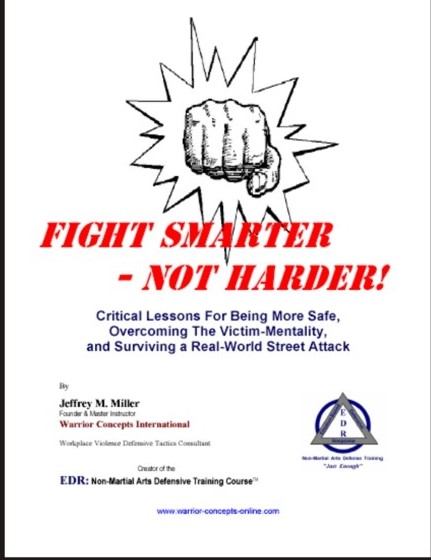
For readers who want to explore these ideas further, I’ve collected several short essays that expand on the same principles—why efficiency, adaptability, and judgment matter more than aggression.
FREE WEEKLY ONLINE TRAINING FROM DAI-SHIHAN MILLER!

Mindset, Life-Master, and Warrior Living for the modern protector!
Monday Evenings at 8pm eastern

Strategies and Tactics to Put More Power & "Bite" in Your Techniques!
Wednesday Afternoons at 3pm eastern
New Accelerated "Foundations of Ninja Self-Defense" Online & Distance Learning Program!

Just because you can fight or carry a gun, doesn't mean you have a broad enough skill set or the skill-proficiency to handle any attacker, any fight style, or any threat scenario that could come at you, quickly, efficiently, and with the least amount of wear-and-tear on your in the process! This "foundations" course has more in it than most full programs! Remember: "The one with the most options has the greatest chance for success!" -- Jeffrey Miller
Ninpo-Masterclass
Online Virtual Ninjutsu-Based Self-Protection Training Classes
with Dai-Shihan Miller!
Proven, Time-Tested Lessons for the Modern Warrior-Protector!
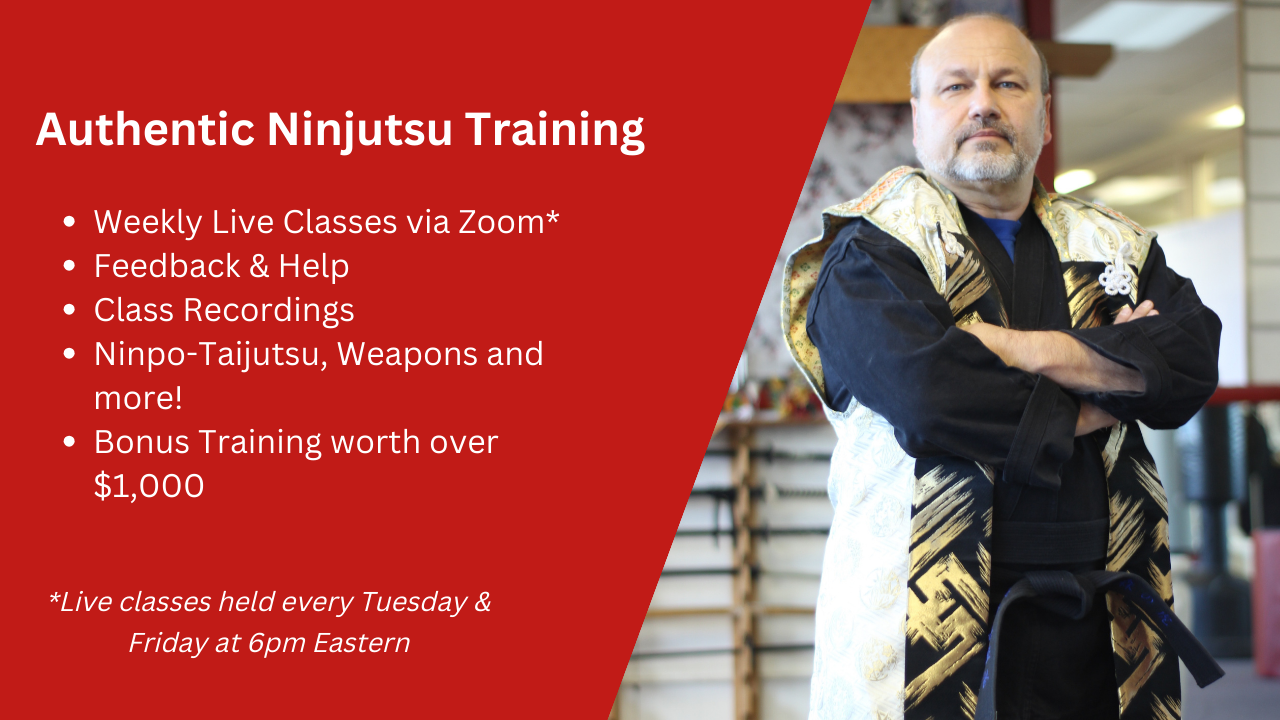
Ninpo-mastery + Group Coaching
Perfect for students ready to deepen their training and receive direct guidance. Includes 6 months of access to weekly Zoom Masterclasses, entry to Seishin Teki Kyoyo, a private strategy session with Jeffrey, and ongoing coaching support. Limited to 10 participants.
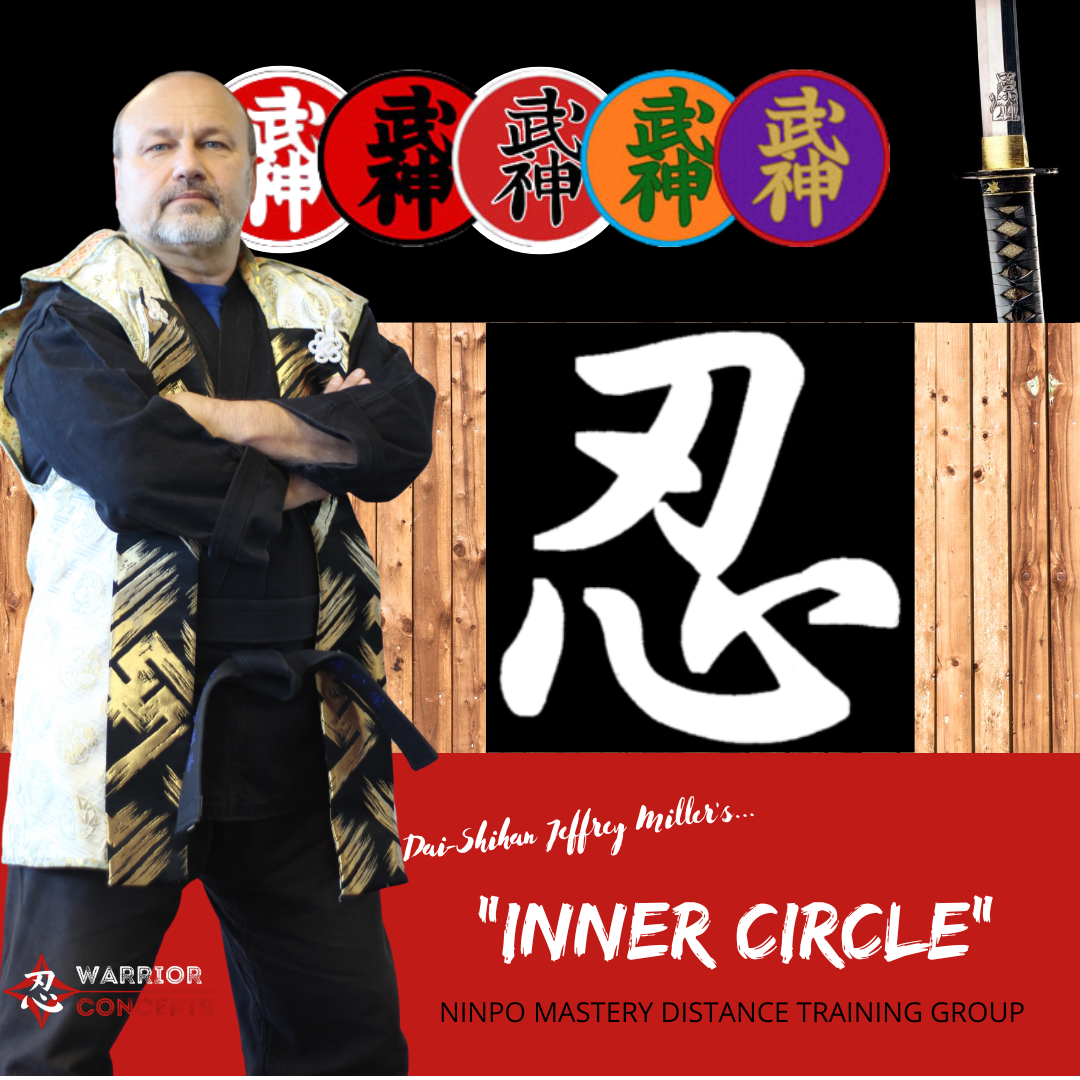
About the Author & Instructor...
Dai-Shihan Jeffrey M. Miller SPS, DTI
About the Master Instructor
Dai-Shihan Miller is one of the longest training students and teachers of Bujinkan Ninjutsu. He has trained with top teachers of the martial and meditation sciences on 3 continents and in 6 countries; including with Soke Masaaki Hatsumi (Grandmaster of 9 historical schools of Japanese warriorship), Senior Japanese and Western Master Teachers, and Rev. Jikai Choffy (ordained teacher of Tendai Mikkyo - Japanese esoteric Buddhist mind-science).
A Personal Note From Dai-Shihan Miller...
Hello and welcome to the Online Ninja Academy...
As a solo and long-distance student myself, I knew the hardships that many students - those who had a burning desire to study the true budo and life mastery teachings of the ancient Ninja and Samurai warriors - had in trying to learn from just videos or books. Many, like me and my own teachers, lacked a qualified dojo in their own area and lived too far from a certified teacher of authentic Ninjutsu.
That's why I created what was to be one of the first online Ninjutsu training programs. Combining the use of internet technologies with a unique curriculum and live training opportunities, I created a means for students to get the access and feedback from a teacher - the greatest issue and objection many had with regards to video and online training. Now, you can join thousands of students, just like yourself, in gaining the benefits, results, and success you've been looking for!

Dai-Shihan Jeffrey M. Miller SPS, DTI
Bujinkan Ninjutsu Master-Teacher
Founder, Warrior Concepts International
Founder & Master Instructor, Bujinkan Mori no Tora Dojo
Internationally-Recognized Author, Speaker, & Consultant Corporate Security, Emergency Management, & Workplace Violence Consultant